
Karma — Balancing Experience
A deeper exploration of karma from the perspective of the Law of One: balance, experience, relationships, recurring lessons, and the evolution of consciousness.
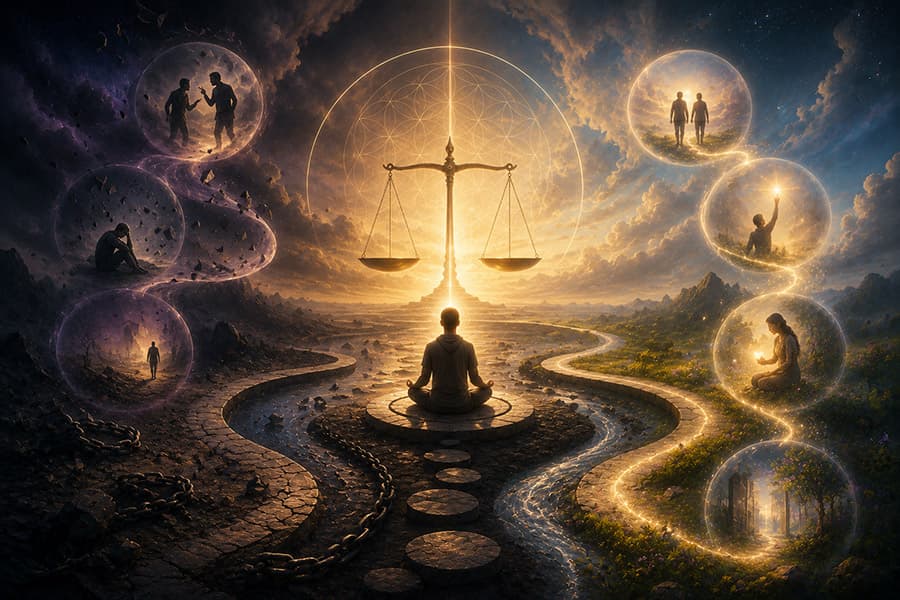
Few spiritual concepts have been simplified, distorted, or misunderstood as much as karma. For some, it represents a cosmic system of rewards and punishments. For others, it is an unavoidable form of destiny controlling human life. Within the perspective of The Law of One, however, karma appears in a different light.
Karma is not presented as an external force judging beings, but as a natural mechanism through which consciousness seeks balance, understanding, and integration. It does not exist to punish, but to create opportunities through which experience may become wisdom.
“Karma does not represent the revenge of the universe, but the tendency of consciousness to restore harmony within experience.
What Is Karma
From this perspective, karma may be understood as the tendency for unintegrated experiences to return into the field of consciousness. When certain lessons remain incomplete or certain imbalances persist, experience may reappear through different forms.
This return should not be viewed as punishment. It represents rather the continuation of a process through which the being attempts to understand more deeply the effects of its own choices and the relationship between self and others-selves.
Karma does not force experience; it creates tendencies through which consciousness may continue the process of balancing.
Karma and Free Will
A common risk is interpreting karma as rigid destiny. If everything were already fixed, then free will would lose its importance. Within the Law of One, however, choice remains central.
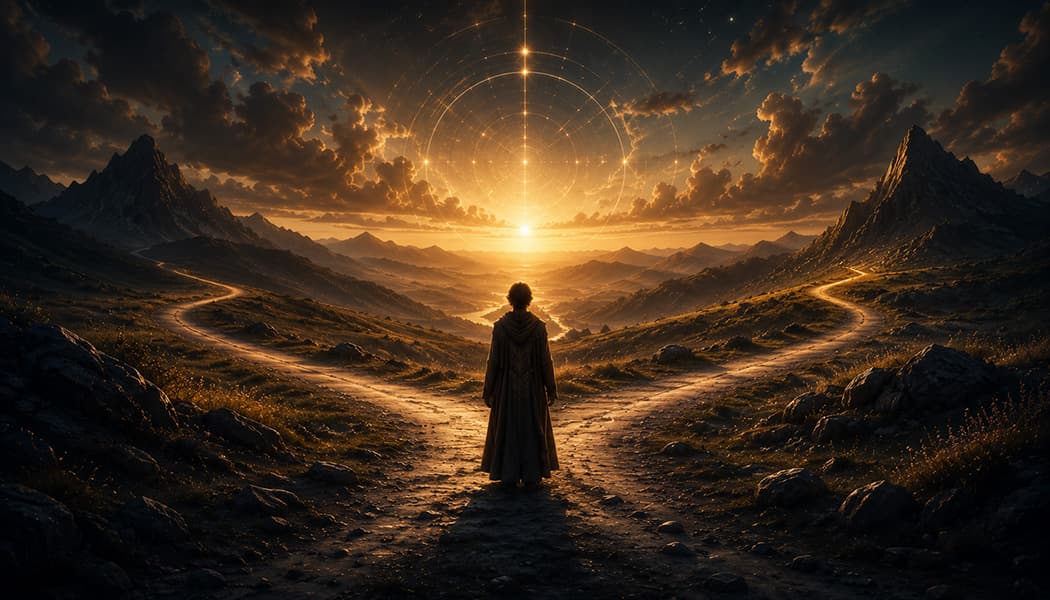
Experiences may create repetitive contexts or predispositions, but how the being responds to those contexts remains open. Karma may place the lesson before consciousness, but it cannot force consciousness to learn it.
“Karma may create the encounter with the lesson. Choice determines the relationship with the lesson.
Why Certain Experiences Repeat
Sometimes people notice recurring patterns: similar relationships, repeated conflicts, persistent fears, or difficulties that continuously reappear. From this perspective, repetition may indicate the presence of processes that remain unintegrated.
These repetitions closely resemble what the article about catalyst describes as recurring transformative experiences. When experience does not generate sufficient clarity, it may return in different forms.
Repetition does not necessarily mean failure. Sometimes it simply indicates that the process of understanding remains active.
Karma and Human Relationships
Many spiritual traditions associate karma with relationships. Within the perspective of reincarnation, certain connections may continue across multiple lifetimes in order to facilitate learning, reconciliation, or the deepening of shared lessons.
Thus, some intense relationships may function as accelerated spaces for learning. Not every difficult relationship is karmic, and not every karmic relationship is difficult. Yet relationships may sometimes become powerful mirrors reflecting the unbalanced aspects of consciousness.
This perspective may be viewed as complementary to the article about reincarnation, where the continuity of soul experience becomes more visible.

Karma and the Polarization of Consciousness
Every karmic experience may also become a context for polarization. When human beings respond through compassion, responsibility, and awareness, the direction of consciousness begins to clarify.

The same experience may also produce closure, resentment, control, or separation. Thus, karma does not automatically produce evolution. It merely creates the conditions through which choice becomes more visible.
“Karmic experience does not determine the direction of consciousness. It merely amplifies the possibility of choice.
Can Karma Be Dissolved
From this perspective, karma is not something that must be mathematically repaid. It may begin transforming when experience produces genuine understanding, balancing, and integration.
Sometimes this process involves forgiveness. Other times it involves healthy boundaries, responsibility, compassion, or deeper processes of healing. What matters is not merely the external event, but the inner transformation produced through experience.
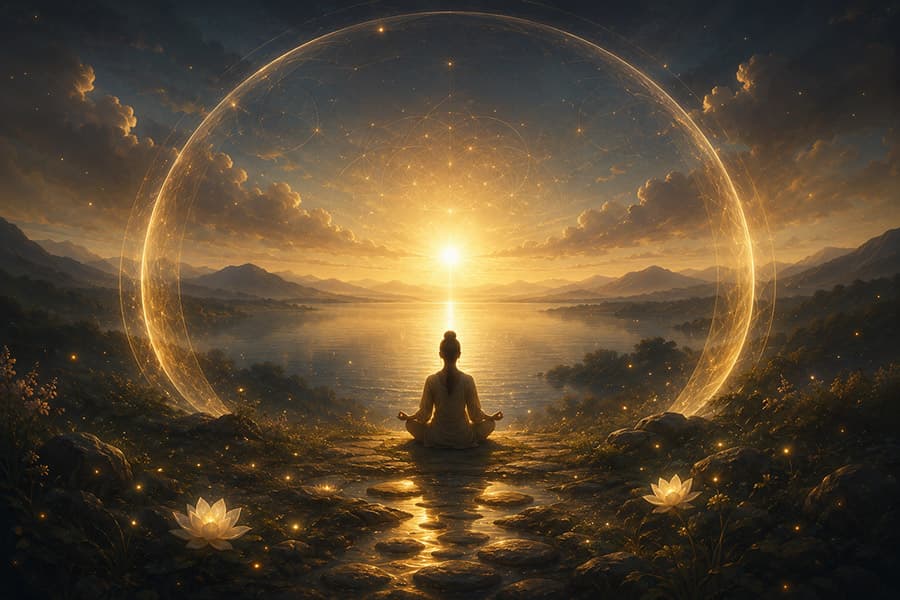
Karma begins transforming when consciousness responds differently to experience than it previously did.
A More Gentle Perspective on Karma
Perhaps the most important shift introduced by this perspective is abandoning the image of a punitive reality. Karma should not be used to judge the suffering of others, nor to superficially explain difficult experiences.
Viewed this way, karma becomes less a condemnation and more an invitation: to observe what experience attempts to balance, reveal, or transform within consciousness.
Summary
Within the perspective of the Law of One, karma represents the tendency of consciousness to seek balance through experience. It does not function as cosmic punishment nor as rigid destiny, but as a process through which unintegrated lessons return until understanding, conscious choice, and inner transformation emerge.