
Catalyst — How Experience Transforms Consciousness
Why do difficult experiences arise and how do they shape inner evolution? An exploration of the concept of catalyst from the perspective of the Law of One.

Some experiences seem to appear precisely when we do not want them. Losses, conflicts, rejection, difficult encounters, obstacles, or unexpected changes often seem like meaningless interruptions. From an ordinary perspective, life sometimes appears to be a random succession of pleasant and unpleasant events. From the perspective of The Law of One, however, experience takes on a different dimension.
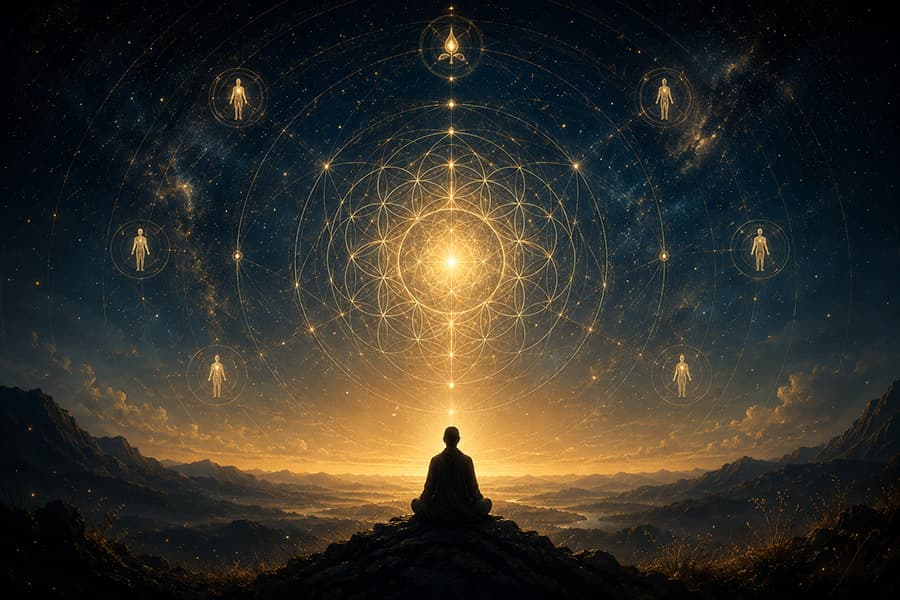
Ra uses the concept of catalyst to describe experiences that create inner movement. Catalyst does not simply represent what happens to us, but what creates the conditions through which consciousness may become more aware of itself.
“Experience does not automatically transform consciousness. The way we respond to experience creates transformation.
What Is Catalyst
In a spiritual sense, catalyst may be understood as any experience that creates reaction, friction, emotion, reflection, or choice. A conversation, an illness, a separation, an opportunity, an injustice, or even a profoundly beautiful experience may become catalyst.
Catalyst does not exist to punish nor to reward. It creates the context through which consciousness may learn, integrate, and evolve. For this reason, the same experience may profoundly transform one person while passing almost unnoticed through another.
Catalyst is not the experience itself, but the transformative potential hidden within experience.
Why Difficult Experiences Arise
Many people wonder why difficult experiences arise if the universe is built upon unity and evolution. In this perspective, contrast becomes the instrument through which consciousness may observe itself more clearly.
Without challenges, many patterns would remain invisible. Fear appears when uncertainty appears. Attachment becomes visible when loss becomes possible. Control reveals itself when reality can no longer be controlled.
Thus, difficult experiences may become raw material through which the being begins observing what previously remained hidden.
“Sometimes experience does not arrive to stop our path, but to reveal the path we still refuse to see.
Catalyst and Choice
Catalyst alone does not produce evolution. Two people may live through the same experience and emerge from it completely differently. The central element always remains free will.

Experience creates pressure upon consciousness, but choice always belongs to the being. We may respond through closure or openness, resentment or understanding, fear or courage.
Catalyst creates the possibility for transformation. Choice determines the direction of transformation.
Catalyst and Polarization
Within the Law of One, experience contributes directly to the process of polarization. Every difficult situation creates repeated opportunities for choice.

When someone responds to challenges through compassion, responsibility, and openness, consciousness polarizes in a certain direction. When responses emerge through control, manipulation, or profound separation, polarization may orient differently.
Life thus becomes less a succession of events and more a continuous process of clarifying inner direction.
Why Lessons Repeat
Sometimes people notice that certain patterns constantly reappear: similar relationships, similar conflicts, recurring fears, or repeated difficulties. In this perspective, repetition does not necessarily represent punishment, but the possibility of revisiting an unintegrated lesson.
When catalyst does not create sufficient transformation, experience may return in different forms until a genuine change in inner response appears.
“Consciousness does not repeat lessons because it has failed, but because something may still be understood more deeply.
Catalyst and Healing
Many processes of healing begin when human beings stop viewing experience only as a problem and begin observing what the experience attempts to bring to the surface.

Catalyst may reveal hidden wounds, unprocessed fears, repressed needs, or ignored inner conflicts. In this sense, painful experience may sometimes become the doorway through which integration begins.
Catalyst does not guarantee healing, but often creates the conditions through which healing becomes possible.
Another Perspective on Experience
Viewing life through the concept of catalyst does not mean justifying suffering, nor becoming passive in the face of difficulty. It simply introduces a new question: what is this experience attempting to show me about myself?
Sometimes the answer appears quickly. Other times it may take years. Yet simply changing the question may transform the way consciousness relates to experience.
Summary
Within the perspective of the Law of One, catalyst represents experience that creates opportunities for inner transformation. Difficult experiences are not automatically viewed as punishment, but as contexts through which consciousness may observe, integrate, and choose. Evolution is not produced by experience itself, but by the conscious response the being offers to experience.