
Reincarnation — The Continuing Journey of Consciousness
A profound exploration of reincarnation through the perspective of the Law of One: the soul, forgetting, life lessons, karmic relationships, and the evolution of consciousness through experience.

There are questions that arise within the being not as simple intellectual curiosities, but as echoes of a deeper memory. Why do certain encounters seem to carry an impossible sense of familiarity? Why do some fears, talents, or inner attractions feel as though they do not come only from this life? Why do certain experiences repeat themselves until we learn to perceive them differently?
Reincarnation attempts to answer these questions through a broader perspective on existence. Life is no longer viewed as an isolated event strictly bounded by birth and death, but as a stage within a much vaster journey of consciousness. The being is born, forgets, chooses, suffers, loves, learns, and through all of this gradually refines its understanding of itself.
“Life is not a random appearance within matter, but a temporary stage upon which consciousness encounters its own lessons.
Reincarnation in the Perspective of the Law of One
Within The Law of One, reincarnation is not presented as punishment nor as a mechanical obligation imposed upon the soul. It appears rather as an evolutionary process through which consciousness returns to incarnated experience in order to continue learning, balancing, and inner polarization.
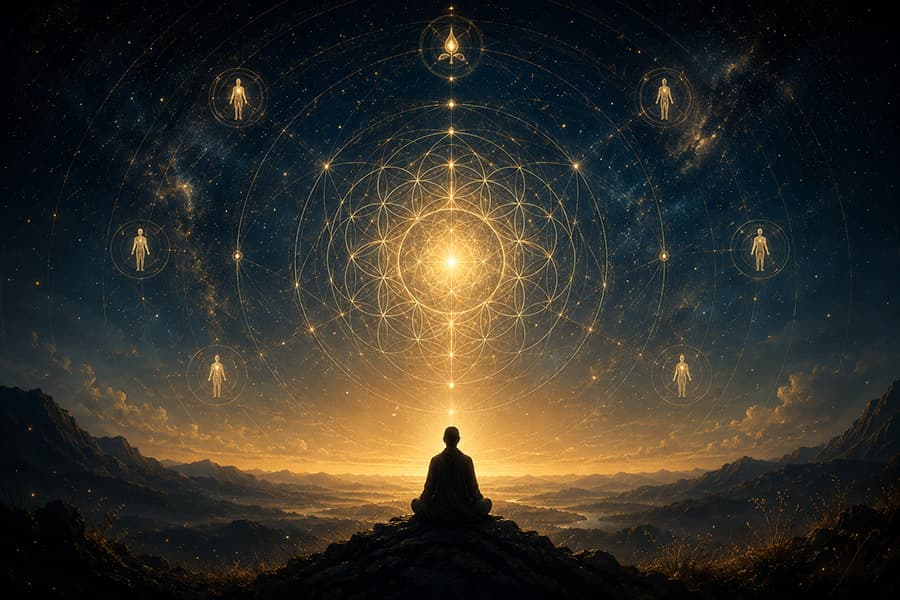
The soul, or mind/body/spirit complex, is not reduced to the personality of a single life. The current personality is a temporary expression formed by memory, context, relationships, choices, and conditioning. Beyond it exists a deeper continuity of the being, which accumulates experience from multiple existences and seeks to transform this experience into wisdom.
Reincarnation does not describe a simple return to the world, but the continuity of a consciousness learning through different forms, contexts, and relationships.
From this perspective, each life offers a particular field of experience. Not all details are predetermined, and free will remains essential. Nevertheless, there are certain themes, predispositions, encounters, and challenges that may function as opportunities chosen or accepted before incarnation, so that the soul may work upon specific lessons.
Why We Forget Who We Were
One of the most delicate questions related to reincarnation is this: if the soul has lived before, why does it not remember? Why do we enter this world without clear access to the deeper memory of our own path?
Within the Law of One, forgetting is not an error, but a condition of authentic choice. If human beings fully remembered who they are, what they chose, why they came, and what relationships they hold with every being they encounter, the experience of life would become far less free. The choice of goodness, love, patience, or forgiveness would be influenced by direct knowledge of the spiritual structure behind events.
Forgetting creates the space in which the being may choose not because it knows with certainty, but because it feels, seeks, intuits, and opens itself. It allows love to be discovered in the midst of uncertainty, rather than merely followed as an obvious rule. In this sense, the veil of forgetting becomes a central element of the human experience.

“Forgetting does not erase the deeper truth of the soul, but makes possible its rediscovery through living choice.
Life Planning and the Freedom of Choice
The idea of life planning before birth may easily be misunderstood. It does not mean that every event is fixed in detail or that human beings no longer possess freedom. Rather, it suggests that the soul may enter life with certain themes to explore, certain predispositions, and certain contexts favorable for learning.
One life may be oriented toward the lesson of forgiveness, another toward courage, another toward balance, humility, responsibility, compassion, or discernment. Yet the way these lessons are lived remains open. Human beings may respond through closure or openness, through fear or trust, through control or love.
Life planning provides a framework for experience, but free will determines how consciousness responds within that framework.
This nuance is essential. Reincarnation should not be transformed into a rigid explanation for every form of suffering, nor into a reason for judging those who are struggling. To say that an experience may have an evolutionary role does not mean minimizing the pain of the one living through it. On the contrary, a mature perspective on reincarnation calls for more compassion, not less.
Why the Soul Would Choose Difficult Experiences
Viewed only from the perspective of personality, suffering often appears absurd. Human beings do not desire loss, illness, rejection, loneliness, or conflict. Yet from a broader perspective, certain difficult experiences may become catalysts for inner awakening. They bring to the surface parts of the being that might otherwise remain hidden.
A difficult relationship may reveal the need for boundaries. A loss may open profound questions about meaning. An injustice may awaken courage. An old wound may become the doorway through which the human being discovers healing. Not because pain is good in itself, but because, within the world of polarity, consciousness may use even contrast in order to know itself more clearly.
“Catalyst is not punishment, but the raw material through which the being may choose a new form of response.
This perspective must be held with delicacy. It does not justify evil and does not ask for passivity in the face of suffering. Within the Law of One, compassion, help, healing, and service to others-selves remain fundamental expressions of orientation toward love. To understand the role of catalyst does not mean abandoning someone within their pain, but seeing within that pain a call toward presence, support, and transformation.
Karma as Balancing, Not Punishment
In many popular interpretations, karma is understood as a system of cosmic punishment: you did wrong, therefore you must pay. Yet such an image is too simplistic and often lacking in compassion. From a deeper perspective, karma may be viewed as a law of balancing experience.
What has not been understood, loved, integrated, or balanced tends to return within the field of experience. Not in order to condemn the being, but to offer the opportunity to see more clearly, choose differently, and restore harmony where distortion once existed.
Karma is not the revenge of the universe, but the tendency of consciousness to seek balance through experience and understanding.
Thus, a karmic lesson should not be viewed as a sentence, but as an invitation. It may appear in the form of a recurring relationship, an emotional pattern, a persistent fear, or a situation repeating itself until the being responds with greater awareness than before.
Karmic Relationships and Meaningful Encounters
Some relationships enter our lives with a particular intensity. Sometimes we feel as though we knew someone before truly knowing them. At other times, a person awakens within us love, fear, rejection, attachment, or a profound desire for healing. In such encounters, reincarnation offers a language through which the continuity of bonds between souls may be understood.
A karmic relationship is not necessarily a romantic relationship, nor is it automatically a relationship that must be preserved at all costs. Above all, it is a relationship with the potential for learning. Sometimes it brings closeness, other times separation. Sometimes it asks for forgiveness, other times for boundaries. Sometimes it heals through presence, other times through ending.
“Not every important encounter is meant to remain; some are meant to reveal what the soul is ready to understand.
In this sense, relationships become mirrors of evolution. Others-selves show us where we love naturally, where we defend ourselves, where we control, where we flee, and where we are called to open more deeply. Through them, consciousness comes to observe itself in motion.
Reincarnation and the Polarization of Consciousness
Within human experience, reincarnation is closely connected with polarization. Life offers contexts through which the being clarifies its inner orientation: toward service to others-selves through compassion, cooperation, and openness, or toward service to the separate self through control, manipulation, and the accumulation of power over others.

This choice is not made in a single moment, but through thousands of small responses. The way we speak, forgive, refuse, help, assume responsibility, or choose to dominate gradually creates a direction for consciousness. A life is not merely a succession of events, but a space in which the being becomes more clearly what it chooses to be.
Reincarnation provides continuity to the process of polarization: each life becomes a new opportunity to choose the direction of the being more consciously.
Death as Transition, Not as an End
If life is a chapter of consciousness, death can no longer be viewed merely as disappearance. It becomes a passage, a change of state, an exit from the temporary form through which the soul explored a particular experience.
This perspective does not eliminate the pain of separation. Loss remains real to the human heart. Yet it may bring a different light upon the mystery of death: what ends is the form, not necessarily consciousness. What disappears from the visible field may continue within a subtler level of existence.
“Death closes one stage of experience, but does not extinguish the light of consciousness that moved through it.
How This Understanding May Be Lived Today
Reincarnation does not hold value only as a metaphysical idea. It becomes important when it changes the way we live. If life is a school of consciousness, then each day may be approached with greater attention. Each reaction becomes a place of choice. Each relationship becomes an opportunity for clarification. Each difficulty may be met not with resignation, but with the question: what is this experience attempting to reveal within me?
This question does not eliminate outer responsibility and does not require passive acceptance of injustice. It nevertheless adds an inner dimension. Human beings are no longer merely victims of circumstances, but consciousnesses capable of transforming their response to circumstances.
To live with the perspective of reincarnation means to view life as a process of learning, not as an isolated and meaningless accident.
A Journey Greater Than Memory
Perhaps we do not clearly remember who we once were. Perhaps we do not know all the paths we have walked or all the faces through which we have looked upon the world. Yet sometimes, deep within the being, we feel that life possesses a continuity the mind cannot fully prove, but the heart may intuit.
Reincarnation should not be transformed into an imposed certainty, but may instead be received as a spiritual map. It invites us to view existence with greater patience, relationships with greater depth, and suffering with greater discernment. Rather than seeing life as a single attempt enclosed between two limits, we may begin to see it as a living fragment of consciousness’s journey toward an ever deeper understanding of love and unity.
Summary
Reincarnation describes the evolutionary continuity of consciousness through multiple life experiences. Within the perspective of the Law of One, the soul returns to incarnation not for punishment, but for learning, balancing, and polarization. Forgetting makes authentic choice possible, relationships become mirrors of inner lessons, and death appears as a transition between stages of the same spiritual journey.