
The Ego - Illusion, Protection, or Tool?
An exploration of the ego from the perspective of the Law of One: identity, separation, protection, control, and the relationship between personality and deeper consciousness.

Few spiritual concepts generate as much confusion as the ego. For some, it is the source of all human problems. For others, it is an obstacle that must be completely eliminated in order to reach enlightenment. Within the perspective of the Law of One, however, the ego may be viewed in a more nuanced way.
Rather than being considered an enemy of evolution, the ego may be understood as a temporary mechanism of human experience. It plays an important role in the development of individual identity, yet it may also become a source of limitation when it is mistaken for the deeper nature of the being.
“The problem is not the existence of the ego, but forgetting that we are more than the ego.
What Is the Ego
In a broad sense, the ego represents the image we hold of ourselves. It includes our name, roles, beliefs, preferences, personal story, and the way we relate to the world.
This structure is not inherently negative. It allows consciousness to function within an individual experience and navigate the complexity of human life. Without some form of personal identity, embodied experience would become difficult to manage.
The ego may be viewed as an interface between consciousness and human experience.
Why Does the Ego Arise
From the perspective of the veil of forgetting, consciousness enters an experience in which it no longer fully perceives its deeper nature. In order for this experience to be possible, a distinct sense of individuality emerges.

The ego contributes to this experience of apparent separation. It provides a unique point of view on reality and allows for the exploration of choices, relationships, and personal lessons.
“The ego does not create consciousness. It creates the perspective through which consciousness experiences individuality.
The Ego as a Protective Mechanism
Many reactions associated with the ego arise from a desire for protection. The need for control, defensiveness, constant validation, or difficulty accepting criticism may all be expressions of a system attempting to preserve the stability of personal identity.
When a person feels that their self-image is being threatened, the ego often reacts automatically. These reactions do not necessarily arise from malice, but from an attempt to avoid discomfort, uncertainty, or vulnerability.
Many ego mechanisms attempt to protect what we perceive as our identity.
When the Ego Becomes a Limitation
Difficulties arise when temporary identity is mistaken for the entirety of the being. At that point, opinions become identity, roles become identity, and experiences become identity.
In contrast to the perspective presented in the article about the unity of consciousness, the ego tends to perceive reality through separation, comparison, and difference. This perspective may be useful for experience, yet it becomes limiting when treated as the only reality.
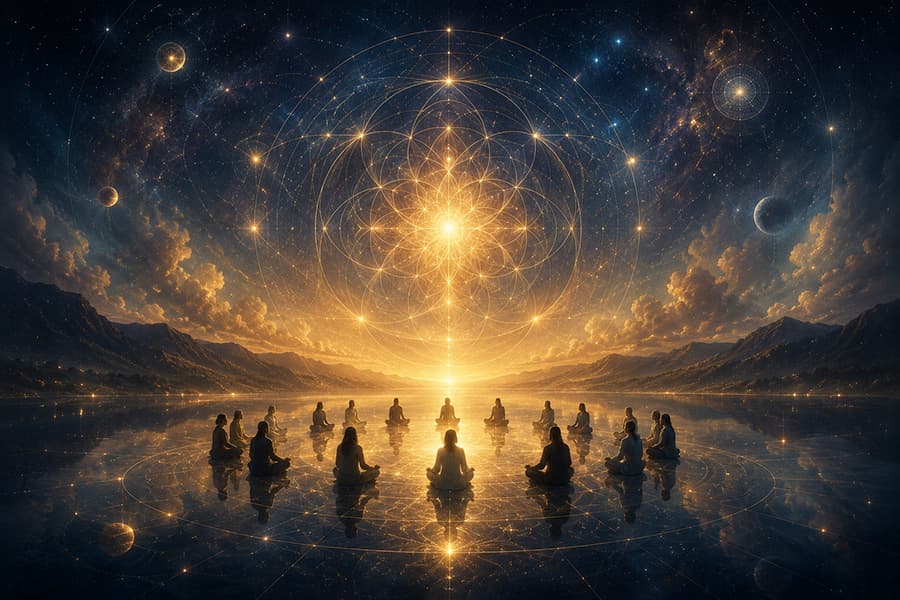
“The ego sees differences. Deeper consciousness perceives the connection behind those differences.
The Ego and Catalyst
Many of the difficult experiences described in the article about catalyst bring ego structures to the surface that would otherwise remain hidden. This is precisely why challenges can become powerful tools for self-discovery.

When conflict, rejection, failure, or loss arise, automatic reactions become more visible. Rather than being viewed exclusively as problems, such moments may become opportunities for observation and understanding.
Catalyst does not create the ego. It reveals aspects of the ego that were already present.
The Ego and Meditation
The practice described in the article about meditation provides a space in which thoughts, emotions, and reactions may be observed without complete identification with them.

As observation becomes more stable, it becomes possible to recognize that mental experiences are real, yet they do not define the entirety of the being's identity. This does not eliminate the ego; it changes the relationship with it.
“Observation does not destroy the ego. It reduces exclusive identification with the ego.
Integration or Elimination
Many popular interpretations speak about the need to destroy or kill the ego. From this perspective, a more balanced approach is integration. The ego may continue to exist as a functional tool without occupying the center of the entire experience.
The goal is not the elimination of personality, but the recognition that personality is only a temporary expression of a much larger consciousness.
Evolution does not require the destruction of the ego, but placing it within a broader context of consciousness.
Summary
Within the perspective of the Law of One, the ego is not an enemy that must be eliminated, but a temporary mechanism of human experience. It facilitates individuality, protection, and navigation through life, yet it may become limiting when mistaken for the entirety of identity. Through observation, meditation, and self-discovery, the relationship with the ego may become more conscious and balanced.