
The unity of consciousness
How the Law of One approaches the idea that all beings, experiences, and forms of existence emerge from the same fundamental source of consciousness.
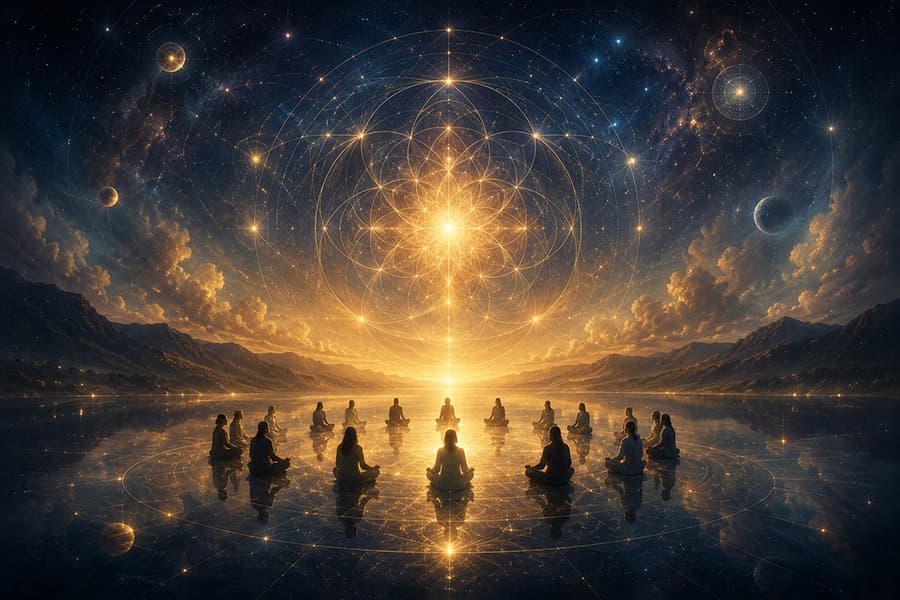
One of the central ideas of The Law of One is that all existence originates from a single infinite source of consciousness. Beyond the differences between people, life forms, or individual experiences, this perspective suggests that everything that exists represents different expressions of the same fundamental reality.
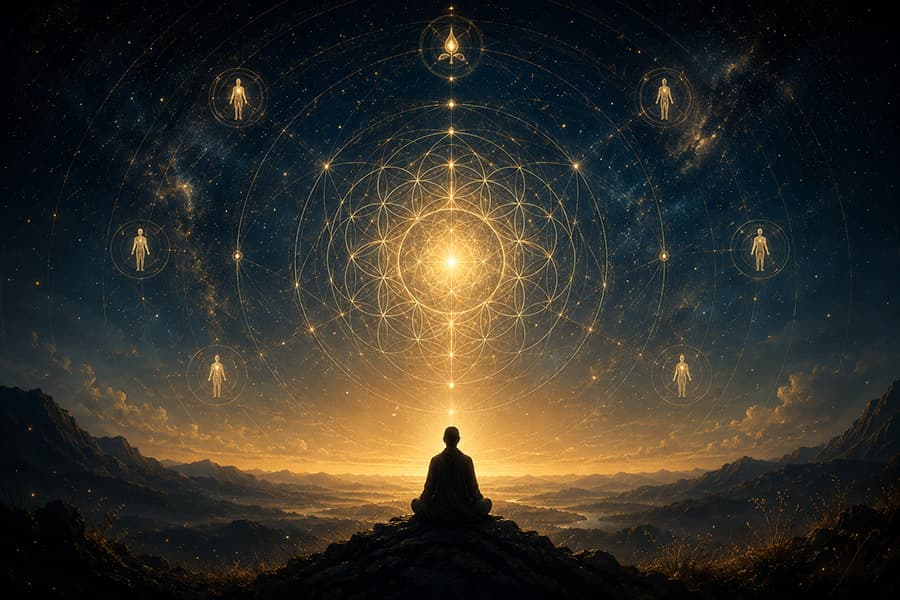
Within this vision, separation is not considered absolute, but rather a temporary experience of perception. Beings appear distinct in order to explore individuality, choice, and experience, yet at a deeper level all remain connected within the same universal consciousness.
“Unity does not mean the disappearance of diversity, but the recognition that diversity arises from the same source.
The Illusion of Separation
Human experience is built around the sense of individual identity. Human beings perceive themselves as separate from others, separate from nature, and often separate even from their own inner dimension. The Law of One suggests, however, that this perception serves a precise evolutionary role.
Without the sensation of individuality, human experience would lose its intensity. Relationships, choices, conflicts, love, and the process of self-discovery become possible precisely through the appearance of separation. In this sense, duality is not described as a cosmic mistake, but as a mechanism through which consciousness comes to know itself from different perspectives.
Separation is the experience through which consciousness explores individuality without ever ceasing to be part of the whole.
Others as Mirrors of Consciousness
Within the Law of One, the idea frequently appears that human relationships represent forms of spiritual learning. If all consciousness arises from the same source, then human interactions cease to be merely accidental encounters and become contexts through which the being discovers its own imbalances, fears, attachments, and capacities for love.
Thus, others are no longer viewed exclusively as completely separate entities, but also as mirrors through which consciousness observes itself from other perspectives. Even conflicts or relational difficulties may become opportunities for inner clarification.
“The way we treat others often reflects the deeper relationship we hold with our own consciousness.
Unity and Compassion
From this perspective, compassion does not appear merely as a moral value, but as a natural consequence of understanding unity. If all beings are expressions of the same source, then the suffering, manipulation, or destruction of others no longer represents merely external actions, but forms through which consciousness creates imbalance within its own experiential field.
At the same time, this idea does not eliminate discernment or healthy boundaries. The Law of One does not suggest absolute passivity, but the development of a perspective in which even differences, conflicts, and polarities are understood within a broader context of the evolution of consciousness.
Authentic compassion does not arise from obligation, but from recognizing the profound connection between all forms of life.
Unity and Spiritual Experience
Many spiritual traditions have described moments in which the sense of individuality seems to temporarily dissolve into an experience of profound unity. In such states, people often report the feeling that no absolute boundaries remain between themselves, others, and existence.
The Law of One interprets these experiences as partial reflections of the true nature of consciousness. Individuality continues to exist, yet it is perceived as an integrated part of an infinitely greater whole.
“Consciousness may experience separation, yet its deeper nature remains unity.
Why This Perspective Is Difficult to Live
Although the idea of unity may appear beautiful at a conceptual level, human experience is often dominated by fear, conflict, trauma, and deep identification with the individual personality. For this reason, people tend to perceive separation as completely real and permanent.
The Law of One suggests that spiritual evolution does not require the denial of human experience, but the gradual integration of a broader perspective on existence. The process is gradual and involves inner observation, awareness, and transformation in the way the being relates to itself and to others.
Unity is not merely a philosophical concept, but a state of perception that begins to transform the way human beings experience relationships and life itself.
A Perspective on Existence
Viewed through the lens of the Law of One, existence ceases to be merely a succession of separate events and becomes a vast process through which consciousness explores infinite forms of experience. Individuality, relationships, and even life’s difficulties thus acquire a profoundly different meaning.
Within this perspective, human beings are not merely isolated observers of the universe, but active parts of an infinite consciousness learning to discover itself through every lived experience.
Summary
The Law of One presents unity as the fundamental nature of existence. Although human experience is built around individuality and the appearance of separation, all beings and experiences are described as expressions of the same infinite consciousness. Through relationships, choices, and inner evolution, consciousness gradually rediscovers the profound connection that exists beyond the appearance of separation.